Pierce & Pierce office
American PsychoThe Pierce & Pierce office is the enclosed corporate world where Patrick Bateman’s professional self is repeatedly manufactured and displayed. It presents work as a choreography of clothes, names, reservations, files, telephones, and controlled manners, yet the same space also becomes the setting in which violence, criminal investigation, bodily distress, and psychological disintegration press through the polished surface. Its decisive significance lies in that contradiction: the office appears to guarantee order and identity while continually revealing how fragile and interchangeable both are.
Corporate Setting and Social Performance
The office belongs to Pierce & Pierce, the Wall Street firm associated with Timothy Price and Patrick Bateman’s professional circle. Its inhabitants speak the language of assets, money, motivation, and career value. In a cab leaving Wall Street, Price insists that he is resourceful, creative, young, unscrupulous, highly motivated, and highly skilled, concluding that society cannot afford to lose him because he is an asset. The office is the institutional backdrop that gives such language its authority, converting personal anxiety and ambition into the approved vocabulary of corporate usefulness.
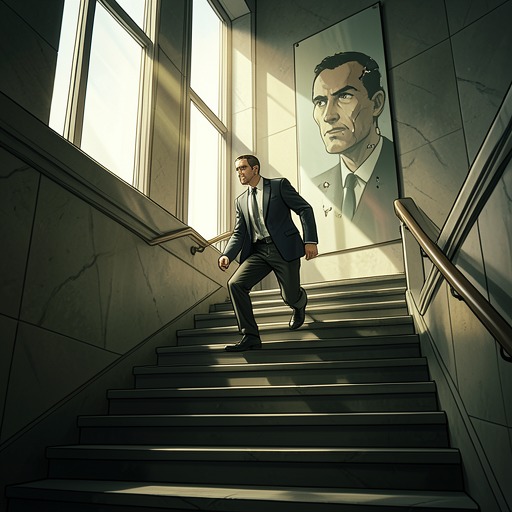
The setting is also a showroom for social distinction. Patrick and his colleagues move through it in expensive suits, shirts, ties, shoes, watches, and accessories whose brands are described with obsessive precision. Frederick Dibble’s appearance in the elevator includes a Canali Milano suit, Bill Blass clothing, a Missoni Uomo raincoat, and an expensive haircut; Patrick’s own Hugo Boss suit, Joseph Abboud shirt, Brooks Brothers shoes, and Bottega Veneta attaché case similarly turn office arrival into a display of rank. Even bodily discomfort is absorbed into the performance: after flossing too hard, Patrick tastes swallowed blood and feels his mouth burning from Listerine, but still manages a smile as he leaves the elevator.
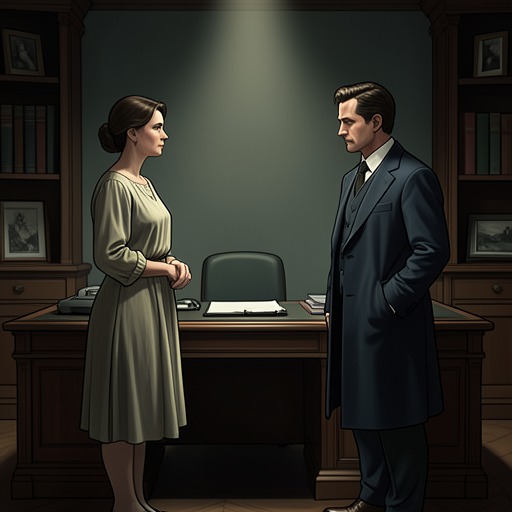
The office’s front-stage order depends on employees who regulate access and maintain appearances. Jean, Patrick’s secretary, anticipates his needs, brings Perrier with lime and the Ransom file, and arranges his lunch reservation at Camols. Patrick is vaguely touched by what he calls her almost total devotion, yet immediately tells her not to wear the outfit again. Her service therefore combines intimacy, hierarchy, and humiliation: she makes the office function while remaining subject to Patrick’s aesthetic judgment.
Routine, Consumption, and Hierarchy
Office life is organized through small acts of consumption and information exchange. In the elevator, Dibble discusses a gossip-column item concerning Ivana Trump and praises an Italian-Thai restaurant on the Upper East Side, while Patrick records the restaurant’s name with a gold Cross pen in his address book. The conversation is casual only in appearance; food, fashion, gossip, and brands form the shared code by which colleagues recognize one another and confirm their membership in the same social world.
The workplace also extends the novel’s recurrent confusion of identity. Patrick encounters Luis Carruthers in a bar and describes him as badly dressed in a Chaps suit, striped shirt, silk bow tie, and Oliver Peoples eyeglasses. Luis notices Patrick, smiles weakly, appears to blush, and turns back to the bar, while the narrator remarks that bartenders always ignore him. The office culture surrounding these men does not merely assign social value; it sorts people according to whether they can perform the expected signs of belonging.
That hierarchy is expressed through objects as much as through speech. At a restaurant, Patrick displays a new business card from a gazelleskin wallet bought at Barney’s and waits proudly for the others’ reactions. The card is not useful information alone: it is a portable emblem of professional identity, a prop intended to establish distinction among men whose lives are otherwise difficult to tell apart. Elsewhere, the accumulation of silk ties and overlapping fragrances produces what Patrick experiences as a cold, sickening perfume, making luxury itself feel oppressive and chemically inhuman.
Investigation and the Breach of Privacy
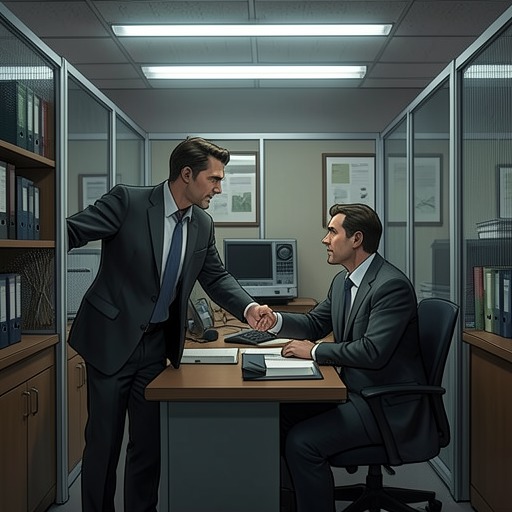
The office becomes more than a workplace when Donald Kimball arrives to investigate the disappearance of Paul Owen. Kimball introduces himself, shakes Patrick’s hand, and explains that Meredith Powell hired him because Luis Carruthers was absent. Patrick attempts to appear friendly and conversational while concealing the three copies of Sports Illustrated and the still-running Walkman spread across his desk. The investigation therefore enters through an ordinary professional encounter, but its presence changes the meaning of the desk and its contents: routine office clutter becomes potential evidence, and hospitality becomes defensive performance.
Kimball’s visit exposes the office’s unstable boundary between corporate business and criminal suspicion. Patrick’s desk remains a controlled surface, but the investigator’s questions force him to manage what is visible, what is hidden, and how he is perceived. The scene makes the office function like an interrogation room without changing its furniture or official purpose. Its procedures are still polite, its conversation still framed as business, but the possibility of legal accountability has entered the space.
The office also connects private desire to institutional anonymity. At a restaurant, Patrick considers whether Courtney Lawrence would spend more time with him if Luis were dead and imagines strangling Luis. He then checks his reflection, confirms that his tan, haircut, and teeth are perfect, puts on leather gloves, and approaches Luis in a deserted men’s room. The violence begins not in an obviously lawless environment but within the same network of elite dining and professional status that the office represents. Appearance is prepared with the care of a workday presentation, while the gloves convert polished self-control into an instrument of concealment.
Collapse of the Corporate Mask
Later, the office becomes the refuge to which Patrick returns after a night of chaos and apparent gunfire. Having shot a night watchman and a janitor in a mistaken building, he reaches what he identifies as his new office, signs in with Gus, rides the elevator upward, and finds safety in the anonymity of the floor. The office does not provide moral safety or legal protection; it provides concealment through institutional familiarity. Signing in and taking the elevator allow Patrick to resume the gestures of an employee even after the surrounding narrative has become a scene of bloodshed and pursuit.
From that office, Patrick calls Harold Carnes and decides to make public what he describes as his private dementia. He leaves a message confessing to dozens or a hundred murders, then watches police cars, ambulances, flares, and a SWAT team gather around the building he has just left. His confession is framed as an office communication, delivered through a telephone and a Rolodex, but it cannot stabilize reality. He sobs while reporting that he left a woman in a parking lot near a Dunkin' Donuts, calls again with a warning that he may appear at Da Umberto's, and finally describes himself as a sick man. The office telephone turns confession into another administrative act: recorded, delayed, and detached from any visible consequence.
The workplace also absorbs Patrick’s bodily and mental deterioration. During a later bad week, he reports drinking his own urine, laughing spontaneously, sleeping beneath his futon, and flossing until his gums ache and his mouth tastes like blood. At the office, Madonna lyrics repeatedly intrude into his thoughts, while the phrase isolated farmhouse returns with nameless dread. He arranges an interview with a reporter who wants to write about him, even as Craig McDermott refuses telephone calls and communicates only by fax. News of bodies recovered from the East River, poisoned Evian bottles, seventeen deaths, zombies, and growing public misunderstanding enters the office alongside management books and calendar work, making social catastrophe indistinguishable from the day’s business.
Narrative Significance
The Pierce & Pierce office is a recurring front stage where identity is produced through controlled surfaces and where those surfaces repeatedly fail. Patrick’s clothes, business card, secretary, files, telephone, Walkman, and Rolodex all help him impersonate a coherent professional, but each object also records strain, concealment, or repetition. The office’s polished procedures coexist with missing colleagues, criminal investigations, unstable names, and violent fantasies, so institutional order becomes a form of camouflage rather than a guarantee of reality.
Its deeper function is to connect Wall Street’s economic abstractions with the novel’s treatment of human beings as interchangeable social objects. Price describes himself as an asset; Patrick’s colleagues are distinguished through nearly identical luxury codes; Luis is ignored when he fails to perform the expected appearance; and Kimball’s investigation enters the firm as an interruption that the office must absorb. The setting therefore embodies both the efficiency and the emptiness of the corporate world: it organizes people brilliantly while remaining unable, or unwilling, to recognize what its performances conceal.